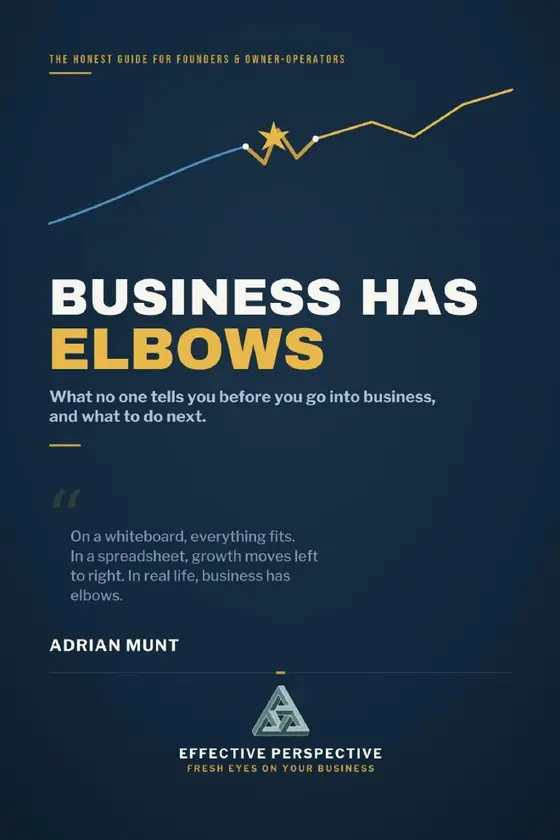
Business Has Elbows
What no one tells you before you go into business, and what to do next. A free book by Adrian Munt, with the Business Reality Check, the seven-step Thrive Mode Framework and a 30-Day Reset you can start this week.
Then the dream meets the job.
Most people go into business for good reasons. More control, more income, more freedom, or the chance to build something they can be proud of. Then suddenly you're not only the expert. You're also the salesperson, estimator, marketer, recruiter, trainer, credit controller, problem solver and, when the money runs short, the bank.
Business isn't hard because you're doing it wrong. It's hard because one good skill, or one good idea, needs an entire business built around it to survive.
This book isn't meant to put you off. It's meant to help you see clearly. If you're thinking about starting, it could save you years of effort and money on the wrong model. If you're already trading and under pressure, it can help you separate the symptoms from the real cause.
- A plain-English test of whether an idea can make money
- A practical way to work out why an existing business feels stuck
- The Business Reality Check, covering demand, pricing, cash, sales, systems and owner outcomes
- The seven-step Thrive Mode Framework, your roadmap out of Struggle Mode
- A focused 30-Day Reset to turn insight into action
Inside
- A great idea isn't yet a business
- Knowing the work isn't knowing the business
- The numbers don't care how exciting the idea is
- Customers rarely break down the door
- Cash buys time to learn
- The owner becomes the bottleneck
- Hard doesn't mean hopeless
- The Business Reality Check
- The seven-step Thrive Mode Framework
- Your 30-Day Reset
- What working with me is like
The Business Reality Check
Rate each statement from 1 to 5. A 1 means unclear or weak. A 5 means clear, evidenced and consistently managed. This isn't a scientific health score. Its only job is to show you where attention is needed.
- We solve a clear and important customer problem.
- We know exactly who our best customers are and why they buy.
- Our price covers true delivery cost, overheads, my own pay and profit.
- We have enough cash visibility to make decisions before a crisis.
- We have a repeatable method for generating and converting sales.
- The business can deliver consistently without everything depending on me.
- We review meaningful numbers and act on them regularly.
- The business is moving me towards the life and outcome I originally wanted.
Score all eight to see where to start.
Look first at the low individual scores, not the total. One serious weakness in cash, margin or demand can outweigh several strengths.
The Thrive Mode Framework
Thrive Mode doesn't mean every week is easy, and the elbows never go away. It means you know where they are, and your business has a clear purpose, sound economics, a reliable route to customers, the ability to deliver, and a rhythm for making decisions.
Struggle Mode
Busy, working hard, and still not sure why it feels so hard.
Thrive Mode
Clear purpose, sound economics, reliable sales, dependable delivery and a decision rhythm.
- Reset the destinationWhat do you actually want from this business?
- Validate the problem and customerWho needs this, and will they pay for it?
- Prove the commercial modelDo the numbers actually work?
- Build an offer people can understand and chooseWhy would a customer choose you?
- Create a repeatable route to salesWhere will your next customers come from?
- Resource and systemise deliveryCan you deliver it well, without everything landing on you?
- Manage, measure and stay accountableHow will you know it's working, and keep it working?
You can work through the seven steps alone, but it's easier with someone alongside who's done it before and asks the awkward questions. See how we can help
Get your copy.
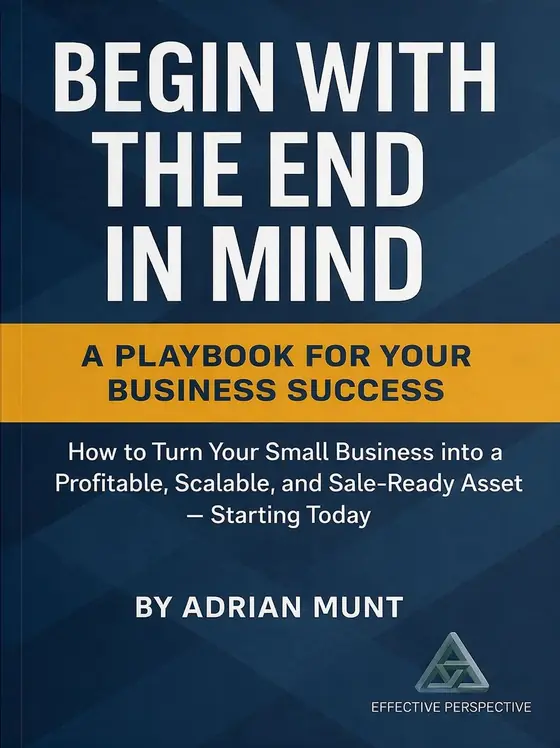
Download Business Has Elbows straight away. If you're thinking about the long-term value of your business, or an eventual sale, ask for Begin With The End In Mind as well.